
Frequentist Model Comparison: Friedman + Nemenyi / Wilcoxon + Holm#
You have trained four backbones on ten benchmark datasets and sorted the results by IQM score (see IQM Tutorial). Some ranking gaps are wide; others are only a few percentage points. Before drawing conclusions you need to ask: which of these gaps can the data actually support?
The frequentist_comparison() method always starts with a Friedman omnibus test to
check whether any difference exists, then applies the appropriate post-hoc test:
All-pairs mode (default): follows the Demšar (2006) / autorank Friedman + Nemenyi workflow, producing a Critical Difference diagram.
Reference mode (
reference=): an evaluma extension — pairwise Wilcoxon signed-rank tests against a named baseline with Holm step-down correction.
Note
This tutorial covers the frequentist approach. For a direct probability statement — “how likely is it that model A outperforms model B on a new task?” — see the Bayesian comparison tutorial. For a comparison of both approaches, see Frequentist vs Bayesian.
import warnings
warnings.filterwarnings("ignore")

import numpy as np
import pandas as pd
import matplotlib.pyplot as plt

import evaluma
1. The Demšar (2006) Protocol#
The key insight in Demšar (2006) is that comparing k > 2 models with pairwise tests directly inflates the false-positive rate. The correct procedure is:
Friedman test (omnibus): Does any classifier differ from the others? This is a non-parametric equivalent of repeated-measures ANOVA that operates on ranks.
Post-hoc test (only if Friedman is significant, or with a warning): Find which specific pairs differ.
evaluma proceeds to post-hoc testing regardless of the Friedman result, issuing a
UserWarning if the Friedman p-value is not below α so you are aware the omnibus test did
not support the direction.
Why ranks in the all-pairs branch?#
Each dataset \(i\) produces one score per model. Converting to ranks per dataset (rank 1 = highest score) removes scale and direction differences between tasks — a 0.78 accuracy and a 0.78 Jaccard index become comparable once both are replaced by their within-dataset rank.
The average rank of a model across N datasets is the primary summary statistic in the Demšar (2006) all-pairs workflow: a model that consistently ranks first has average rank 1. The reference-mode branch does not use average ranks — it tests paired normalized score differences directly via Wilcoxon signed-rank.
2. Toy Example#
A toy benchmark with four models across ten datasets, designed so that some gaps are large and some are not:
rng = np.random.RandomState(34)
datasets = [f"D{i:02d}" for i in range(1, 11)]

scores = {
    "Model-A": np.clip(rng.normal(0.82, 0.03, 10), 0, 1),
    "Model-B": np.clip(rng.normal(0.62, 0.10, 10), 0, 1),
    "Model-C": np.clip(rng.normal(0.47, 0.10, 10), 0, 1),
    "Model-D": np.clip(rng.normal(0.45, 0.10, 10), 0, 1),
}

rows = [
    {"model": m, "dataset": d, "metric": "acc", "score": float(s)}
    for m, sc in scores.items()
    for d, s in zip(datasets, sc)
]
bench = evaluma.load_df(
    pd.DataFrame(rows),
    model="model", dataset="dataset", metric="metric", score="score",
    norm_ref_low=0.0, norm_ref_high=1.0,
)
fig, ax = plt.subplots(figsize=(7, 3.5))
models = list(scores.keys())
means = [scores[m].mean() for m in models]
stds  = [scores[m].std()  for m in models]
x = np.arange(len(models))

ax.bar(x, means, yerr=stds, capsize=4, color="steelblue", alpha=0.6,
       error_kw={"elinewidth": 1.5})
for i, m in enumerate(models):
    ax.scatter(
        np.full(len(scores[m]), i),
        scores[m],
        color="steelblue", s=20, zorder=3, alpha=0.8
    )
ax.set_xticks(x)
ax.set_xticklabels(models)
ax.set_ylabel("Score")
ax.set_ylim(0, 1)
ax.set_title("Per-model scores (mean ± std across 10 datasets)")
plt.tight_layout()
plt.show()
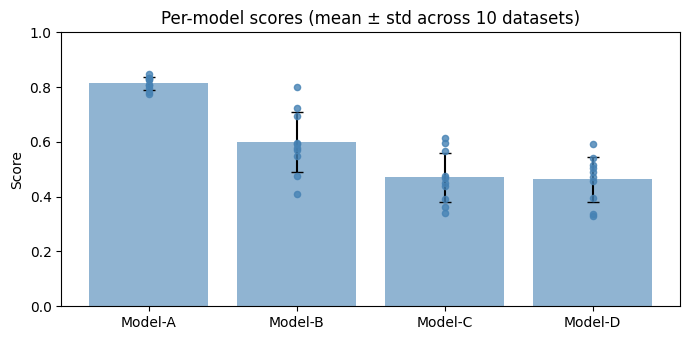
Model-A vs Model-B: A consistent ~20-point lead on every dataset.
Model-C vs Model-D: Means only 0.02 apart with high per-dataset variance — differences reverse direction freely.
Model-B vs Model-C/D: A ~15-point mean advantage that is borderline, given the shared σ ≈ 0.10 noise.
3. All-Pairs Mode: Friedman + Nemenyi#
Running the comparison#
result = bench.frequentist_comparison(alpha=0.05)
print(f"Friedman  χ² = {result.friedman_statistic:.3f},  p = {result.friedman_p_value:.4f}")
print(f"Critical difference (CD) = {result.cd:.3f}")
result.table
Friedman  χ² = 18.600,  p = 0.0003
Critical difference (CD) = 1.483
| model_a | model_b | rank_diff | p_value | significant | |
|---|---|---|---|---|---|
| 0 | Model-A | Model-B | 1.3 | 0.109611 | False |
| 1 | Model-A | Model-C | 2.1 | 0.001570 | True |
| 2 | Model-A | Model-D | 2.2 | 0.000799 | True |
| 3 | Model-B | Model-C | 0.8 | 0.508353 | False |
| 4 | Model-B | Model-D | 0.9 | 0.402376 | False |
| 5 | Model-C | Model-D | 0.1 | 0.998155 | False |
The table has one row per pair. The rank_diff column is \(|\bar{r}_A - \bar{r}_B|\)
where \(\bar{r}\) is the average rank across datasets. The p_value comes from the
Nemenyi test (already FWER-controlled — no additional correction applied).
Column |
Meaning |
|---|---|
|
The pair being compared |
|
\(|\bar{r}_A - \bar{r}_B|\) — difference in average ranks |
|
Nemenyi post-hoc p-value (family-wise error rate controlled) |
|
|
Note
No p_value_corrected column appears in all-pairs mode. The Nemenyi test uses the
Studentized range distribution across all \(k(k-1)/2\) pairs simultaneously, providing
FWER control without a secondary correction step. Applying Holm on top would
double-correct and be over-conservative.
Critical Difference diagram#
The CD diagram (Demšar 2006) converts the result table into a picture of the competitive landscape. The CD scalar marks the minimum rank difference that reaches significance.
fig = result.plot(title="Critical Difference Diagram — toy benchmark, α = 0.05")
plt.tight_layout()
plt.show()
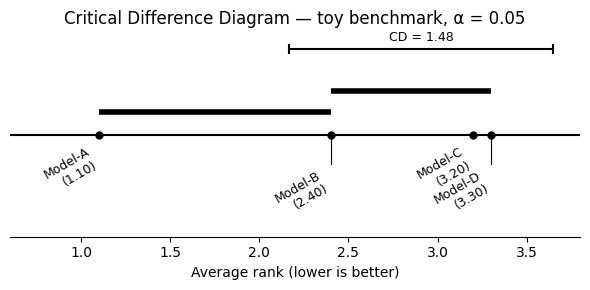
Three rules to read any CD diagram:
Left is better. Models are placed on a horizontal axis by average rank (rank 1 = “scored highest on this dataset”). The leftmost model had the best average rank.
A bar marks a statistically indistinguishable group. A thick horizontal bar connecting two or more models means their rank gap does not exceed the CD scalar — the data cannot confidently separate them.
No bar means a significant difference. Models with no connecting bar are separated by more than the CD, and the Nemenyi p-value is below α.
The CD bracket (top-right) shows what the critical difference looks like on the rank axis. Any two models whose distance on the axis is smaller than the bracket are not significantly different.
What to look for#
Model-A (leftmost) is significantly better than Model-C and Model-D — those rank gaps (2.1 and 2.2) exceed the CD (1.48). The gap between Model-A and Model-B (rank diff = 1.3) falls just below the CD, so they share a bar: the data cannot confidently separate them. A second bar connects Model-B, Model-C, and Model-D, where no gap reaches significance.
CD scalar formula#
The critical difference is:
where \(q_\alpha\) is the \(\alpha\)-quantile of the Studentized range distribution with \(k\) groups and infinite degrees of freedom, \(k\) is the number of models, and \(N\) is the number of datasets.
from scipy.stats import studentized_range

k = 4   # models
N = 10  # datasets
alpha = 0.05
q_alpha = studentized_range.ppf(1 - alpha, k, df=np.inf) / np.sqrt(2)
cd_manual = q_alpha * np.sqrt(k * (k + 1) / (6 * N))
print(f"CD (manual) = {cd_manual:.4f}")
print(f"CD (result) = {result.cd:.4f}")
CD (manual) = 1.4832
CD (result) = 1.4832
4. Reference Mode: Wilcoxon + Holm#
When the question is “which models genuinely improve over a specific baseline?” use
reference=. Unlike the all-pairs branch, this mode tests paired normalized score
differences directly via Wilcoxon signed-rank — not average ranks. It runs only \(k - 1\)
pairwise tests against the reference, then applies Holm step-down correction to control the
FWER across those tests.
result_ref = bench.frequentist_comparison(reference="Model-B", alpha=0.05)
print(f"Friedman  χ² = {result_ref.friedman_statistic:.3f},  p = {result_ref.friedman_p_value:.4f}")
result_ref.table
Friedman χ² = 18.600, p = 0.0003
| model_a | model_b | w_statistic | p_value | p_value_corrected | significant | |
|---|---|---|---|---|---|---|
| 0 | Model-B | Model-A | 1.0 | 0.003906 | 0.011719 | True |
| 1 | Model-B | Model-C | 5.0 | 0.019531 | 0.039062 | True |
| 2 | Model-B | Model-D | 8.0 | 0.048828 | 0.048828 | True |
Column |
Meaning |
|---|---|
|
The reference model (repeated for every row) |
|
The model being compared against the reference |
|
Wilcoxon W statistic (sum of the smaller signed-rank group) |
|
Raw two-sided Wilcoxon p-value |
|
Holm step-down corrected p-value — report this |
|
|
fig = result_ref.plot(title="Wilcoxon vs Model-B baseline, α = 0.05")
plt.tight_layout()
plt.show()
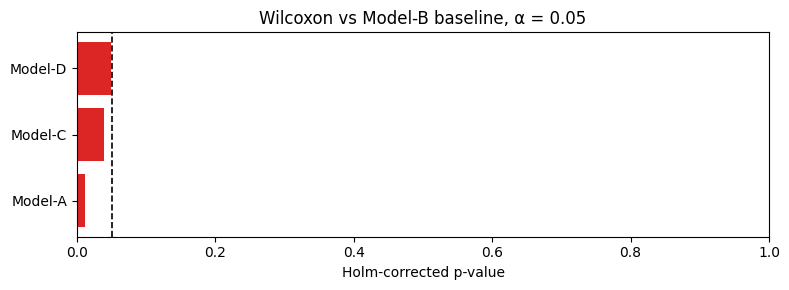
Bars ending to the left of the dashed α line are significantly different from the reference. Grey bars are not.
When to use reference mode vs all-pairs#
Scenario |
Mode |
|---|---|
Understand the full competitive landscape |
All-pairs (Nemenyi) |
“Which models beat my baseline?” |
Reference (Wilcoxon + Holm) |
Reference mode uses fewer tests (\(k-1\) vs \(k(k-1)/2\)) and therefore a weaker Holm correction, giving more power for each individual comparison. Models that are borderline in all-pairs mode may reach significance in reference mode.
5. Applying to GeoBench#
The IQM ranking tutorial showed ConvNeXt backbones leading by a visible
margin. frequentist_comparison tests whether those gaps survive a Friedman + Nemenyi
correction across 14 backbones and 19 datasets.
df_raw = pd.read_csv("../../results_and_parameters.csv")

full_coverage = (
    df_raw.groupby("backbone")["dataset"]
    .nunique()
    .pipe(lambda s: s[s == 19].index)
    .tolist()
)
df_geo = df_raw[df_raw["backbone"].isin(full_coverage)].copy()

bench_geo = evaluma.load_df(
    df_geo,
    model="backbone",
    dataset="dataset",
    metric="Metric",
    score="test metric",
    seed="Seed",
    norm_ref_low=0.0,
    norm_ref_high=1.0,
    metric_direction={"biomassters": "min"},
)
result_geo = bench_geo.frequentist_comparison(alpha=0.05)
print(f"Friedman  χ² = {result_geo.friedman_statistic:.3f},  p = {result_geo.friedman_p_value:.4f}")
print(f"CD = {result_geo.cd:.3f}")
fig = result_geo.plot(title="GeoBench — CD diagram, α = 0.05")
plt.tight_layout()
plt.show()
Friedman  χ² = 61.863,  p = 0.0000
CD = 4.552

The CD diagram shows which backbone gaps the data can actually support after the Nemenyi correction. Backbones sharing a bar occupy the same statistical tier, regardless of their IQM ranking position.
Reference mode: testing against a single baseline#
result_ref_geo = bench_geo.frequentist_comparison(reference="resnet50", alpha=0.05)
fig = result_ref_geo.plot(title="GeoBench — Wilcoxon vs resnet50, α = 0.05")
plt.tight_layout()
plt.show()
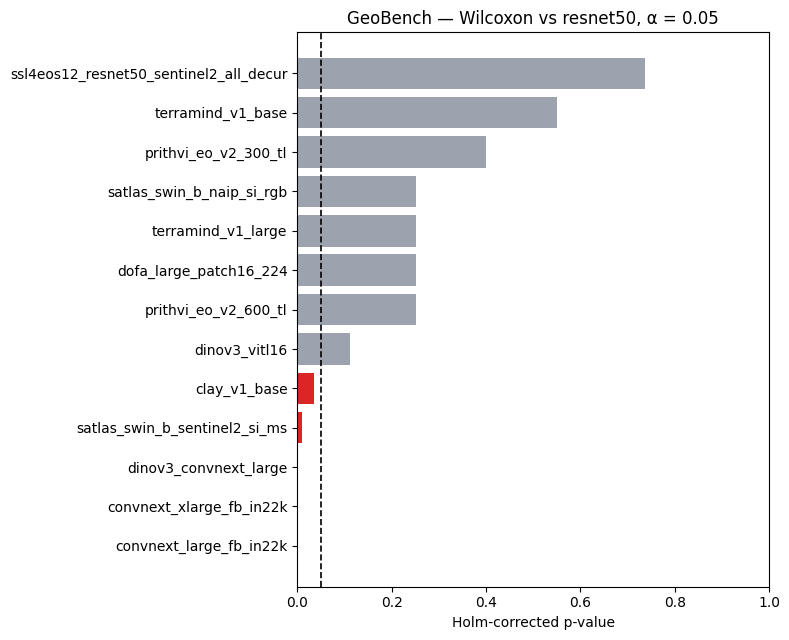
The Holm correction here spans 13 tests (\(k - 1\)) rather than 91 (\(k(k-1)/2\)), giving each comparison more power.
Summary#
Always run Friedman first.
frequentist_comparison()does this automatically and warns if the omnibus test is not significant.All-pairs mode uses Nemenyi, which controls FWER across all pairs simultaneously. No secondary correction is needed or applied.
Reference mode uses Wilcoxon + Holm. Fewer tests mean a weaker correction and higher power per comparison. Use it when one specific baseline defines the question.
The CD diagram is the standard visualization for all-pairs results. Left is better; bars mark indistinguishable groups; the CD bracket shows the critical difference in rank units.
evalumanormalizes scores to [0, 1] per dataset before any statistical test, removing scale and direction differences between metrics.
For a direct comparison of the frequentist and Bayesian approaches, see Frequentist vs Bayesian.
References#
Demšar, J. (2006). Statistical comparisons of classifiers over multiple data sets. Journal of Machine Learning Research, 7, 1–30.
Holm, S. (1979). A simple sequentially rejective multiple test procedure. Scandinavian Journal of Statistics, 6(2), 65–70.
Nemenyi, P. (1963). Distribution-free multiple comparisons. PhD thesis, Princeton University.
Simumba, N. et al. (2026). GEO-Bench: Toward Foundation Models for Earth Monitoring.